History
Curriculum Vision Statement:
Our History curriculum inspires children to develop a deep understanding of themselves, their communities and the wider world by exploring how the past shapes the present. Beginning in EYFS through meaningful exploration of people, places and change, pupils progressively build historical knowledge and understanding throughout their school journey.
Through the study of significant individuals, monarchs, civilisations and historical periods, children develop the core disciplinary skills of comparison, significance and causation. They learn to analyse change over time, evaluate similarities and differences, and understand the impact that people, events and ideas have had on society. By exploring humankind, creativity, and the influence of place and space, pupils gain insight into how cultures, communities and nations have evolved and interacted.
Our curriculum fosters curiosity, critical thinking, communication and historical enquiry, encouraging children to ask questions, challenge assumptions and form evidence-based conclusions. Through engaging end points, including presentations, assemblies and responses to thought-provoking Big Questions, pupils learn to articulate their understanding with confidence and connect historical learning to contemporary Britain and the wider world.
We aim to nurture informed, reflective and responsible citizens who appreciate the richness of our shared heritage and recognise history as a powerful tool for understanding the world today and shaping the future.
How is history taught at St Jerome?
History in EYFS
In EYFS, as an important part of the ‘Understanding the World’ strand of the curriculum, pupils explore the world through the topics: Me and My Community, Once Upon a Time, Starry Night, Dangerous Dinosaurs, Long Ago and Big Wide World.
History in Key Stage 1
In Key Stage 1, children will explore a specific topic each Autumn and Summer. In Year 1 children will begin to understand themselves by exploring the topic Childhood, in which they will create timelines of their own lives alongside a family tree to form an understanding of significant events and the idea of causation. This topic includes a look at childhood in the 1950’s to allow the pupils to begin to compare and contrast as a key historical skill. This skill will then be improved upon in the Summer Term with the topic School Days where the children will think about their school days now alongside what life was like for a Victorian school child.
In Year 2, the children will focus on the idea of significance and what makes somebody significant on a large scale. In the Autumn term, they will first look at significant people in the topic Movers and Shakers in which the children will explore the impact of explorers and activists. In the Summer term, they will then begin to look at the significance and power of rulers with a specific focus on the British monarchy in the topic Magnificent Monarchs.
History in Key Stage 2
Throughout Key Stage 2, students will build on these skills of comparison, significance and causation through investigating specific eras or civilisations. There will be two focuses per year again one in Autumn term and the other in the Summer term. Similarly, the focus of History as a way of understanding the present will be explored in each topic to foster the idea that History allows oneself to understand their present.
End Points
Key Stage 1
During Key Stage 1, the pupils will work towards mini-end points that focus on a specific skill: for example, creating a timeline of monarchs (Comparison) or choosing their most significant figure (Movers and Shakers) and explaining their choice (Significance).
Key Stage 2
During Key Stage 2, there will be two end points to work towards. In one topic, the end point is an assembly where, in groups, the pupils present their learning (Oracy) to the rest of the school/ KS2 and parents. In the other topic, the children will answer a Big Question that aims to capture all of the learning of the topic and link it to modern day Britain/ world.
History Curriculum Map
| Autumn 1 | Autumn 2 | Spring 1 | Spring 2 | Summer 1 | Summer 2 | |
| Year 1 | Childhood | Childhood | School Days | School Days | ||
| Year 2 | Movers and Shakers | Movers and Shakers | Magnificent Monarchs | Magnificent Monarchs | ||
| Year 3 | Through the Ages | Through the Ages | Emperors and Empires | Emperors and Empires | ||
| Year 4 | Invasion | Invasion | Ancient Civilisations | Ancient Civilisations | ||
| Year 5 | Dynamic Dynasties | Dynamic Dynasties | Groundbreaking Greeks | Groundbreaking Greeks | ||
| Year 6 | Britain at War | Britain at War | Maafa | Maafa |
The curriculum builds a knowledge of:
- Change, where children will describe, explain and compare in increasing depth, developing knowledge of the aspect of change and how groups and cultures
- Comparison, where children will evaluate similarities and differences, and this as an effective structure to build their literacy and historical argumentation skills.
- Significance, where children will describe, explain and compare in increasing depth, developing knowledge of the classification of importance and impact of changes made throughout history.
- Humankind, where children will learn how humans have shaped the world around them
- Creativity, where research demonstrates that our shared heritage can inspire curiosity, imagination, critical thinking and new perspectives. This enhances people's innovative capacity; leading to greater productivity.
- Place and space, where children will describe, explain and compare places in increasing depth, developing knowledge about how geographical characteristics can form a group’s: culture, decision making, means of production, governing systems and relationships with neighbouring groups.
History Learning Gallery
Enquiries:
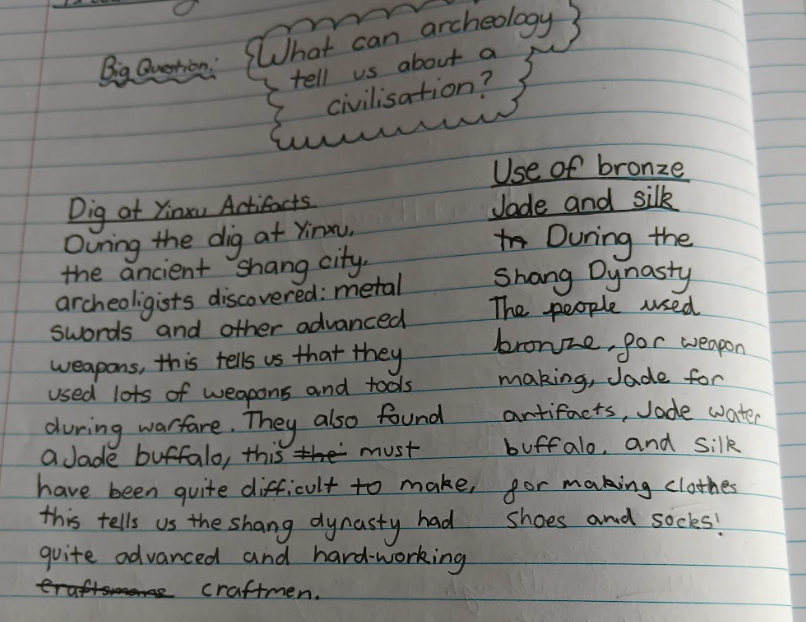
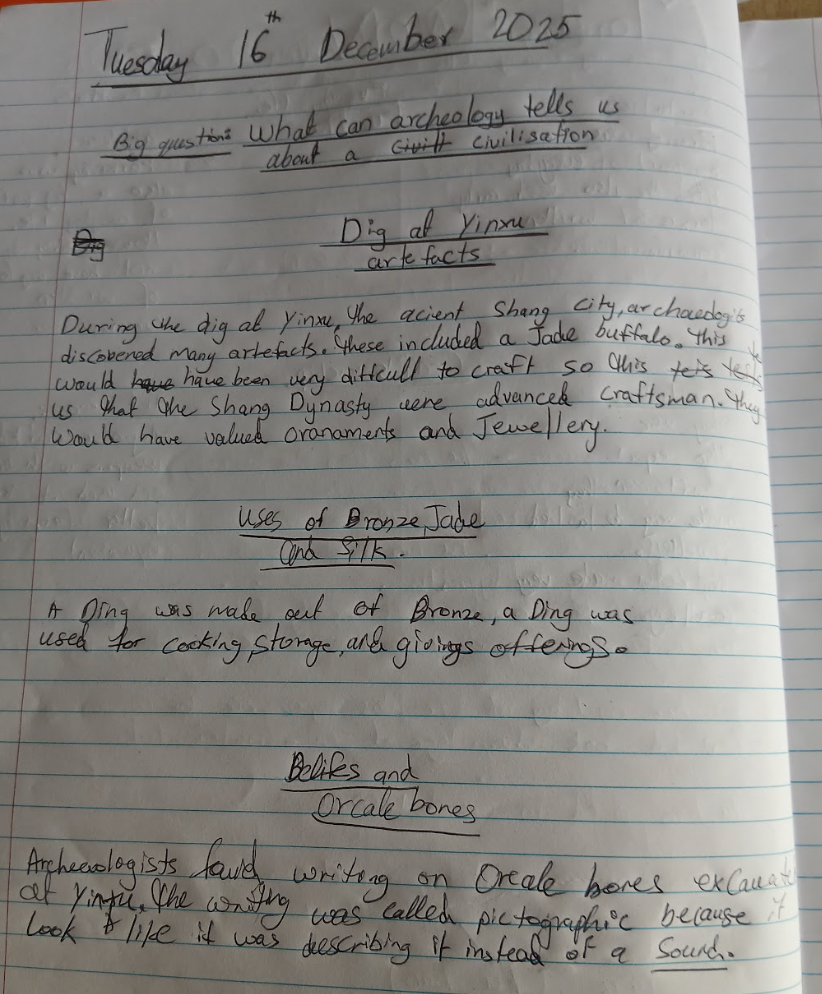
Big Question Responses:
.png)
End of Term Reviews:
Homework:
Useful Links to Support Learning
Great Places to Visit
If you have the opportunity, we are very fortunate to have a number of exciting places in the local area to visit that will support children’s learning in History.